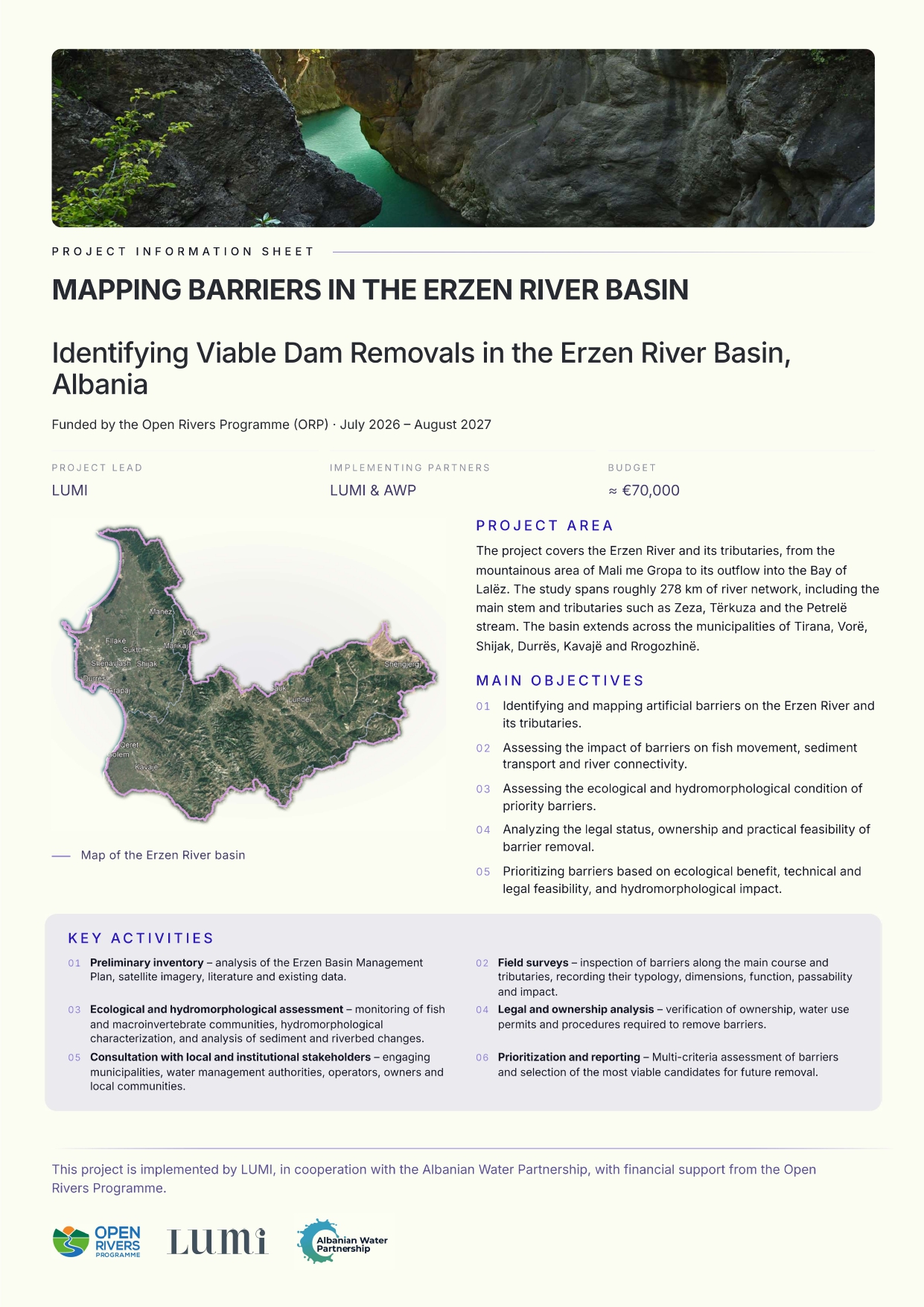
Albanian Water Partnership and LUMI have launched the new project “Mapping barriers to freedom: Identifying viable dam removals in the Erzen River Basin, Albania”. The project will deliver the first comprehensive, field-verified barrier inventory and prioritisation for the Erzen River basin, identifying at least two viable dam removal candidates to advance Albania’s WFD-mandated hydromorphological restoration.
The Erzen River flows 109 km from the Mali me Gropa mountains (1,200 m a.s.l.) through the Tirana-Durrës corridor to the Adriatic Sea at Lalëzi Bay, draining a 760 km² catchment across six municipalities (Tirana, Vorë, Shijak, Durrës, Kavajë, Rrogozhinë) home to roughly 289,000 people. It is the only remaining active sediment supplier to the Gulf of Lalëzi. Upper reaches host endemic freshwater species, including the Albanian trout (Salmo farioides) and Albanian barbel (Barbus albanicus), and are classified Class II (Good) ecological status, while lower reaches have degraded to Class III (Moderate) due to hydromorphological alteration.
Decades of intensive gravel mining (1990-2015) and dam-related modifications have caused channel incision of up to 3 metres, disrupting sediment continuity and river connectivity across the basin. Albania’s Erzen River Basin Management Plan (PMBU Erzen, VKM No. 623, date 8.11.2023), the country’s first legally binding WFD-aligned basin plan, explicitly identifies hydropower structures and channel modifications as key drivers of ecological failure and mandates hydromorphological restoration in its Programme of Measures. Yet no mechanism currently exists to identify which of the basin’s artificial barriers are viable removal candidates.
Albania’s 2022 opening of EU Chapter 27 accession negotiations adds urgency, as barrier removal that improves ecological status directly supports WFD implementation obligations. With limited precedent barrier-removal identification in Albania, the Erzen offers a rare opportunity to extend Europe’s dam removal effort into a Mediterranean-regime, urban-pressured river system, while building a replicable civil-society model for barrier identification across Albania’s remaining basins and the wider Western Balkans.
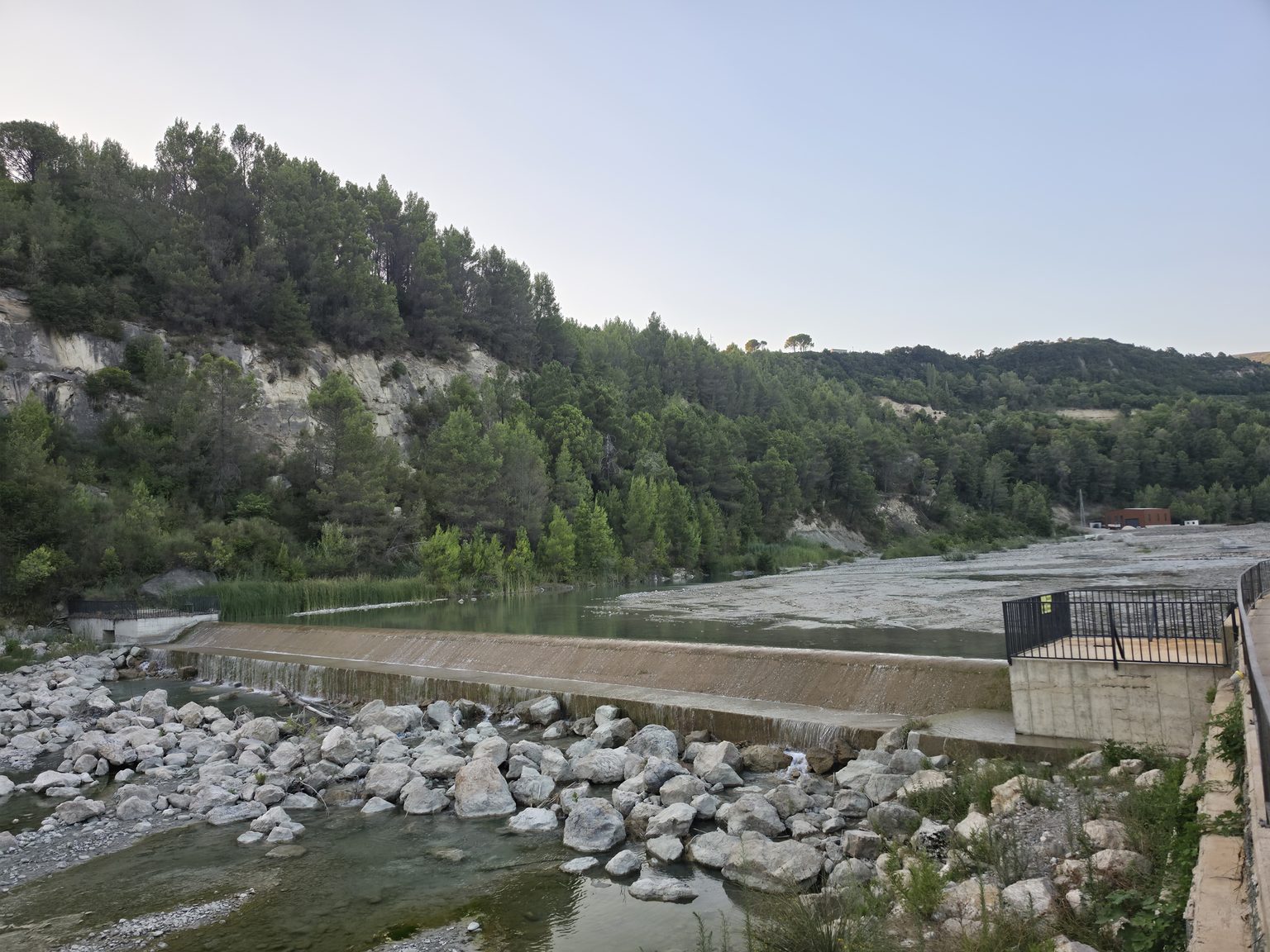
Project aim and deliverables:
This project will deliver the first comprehensive, field-verified barrier inventory and prioritisation for the Erzen basin and its tributaries, combining desk-based mapping, systematic field surveys, geomorphic assessment of gravel-mining legacy impacts, ecological baseline surveys, stakeholder consultation on ownership and removal willingness, and multi-criteria feasibility scoring.
The expected outcome is a bilingual (Albanian/English) technical report, submitted to Albania’s Agency for Water Resources Management (AMBU) for integration into the Erzen RBMP monitoring framework, identifying at least two potential prioritised barriers for removal in a second stage.
Strategic removal of two to three barriers is estimated to reconnect 30-60 km of river, restoring passage for endemic fish such as Salmo farioides and Barbus albanicus and re-mobilising sediment that supports coastal replenishment at Lalëzi Bay, contributing directly to Albania’s WFD obligations and the EU Biodiversity Strategy 2030 target of restoring 25,000 km of free-flowing rivers.